


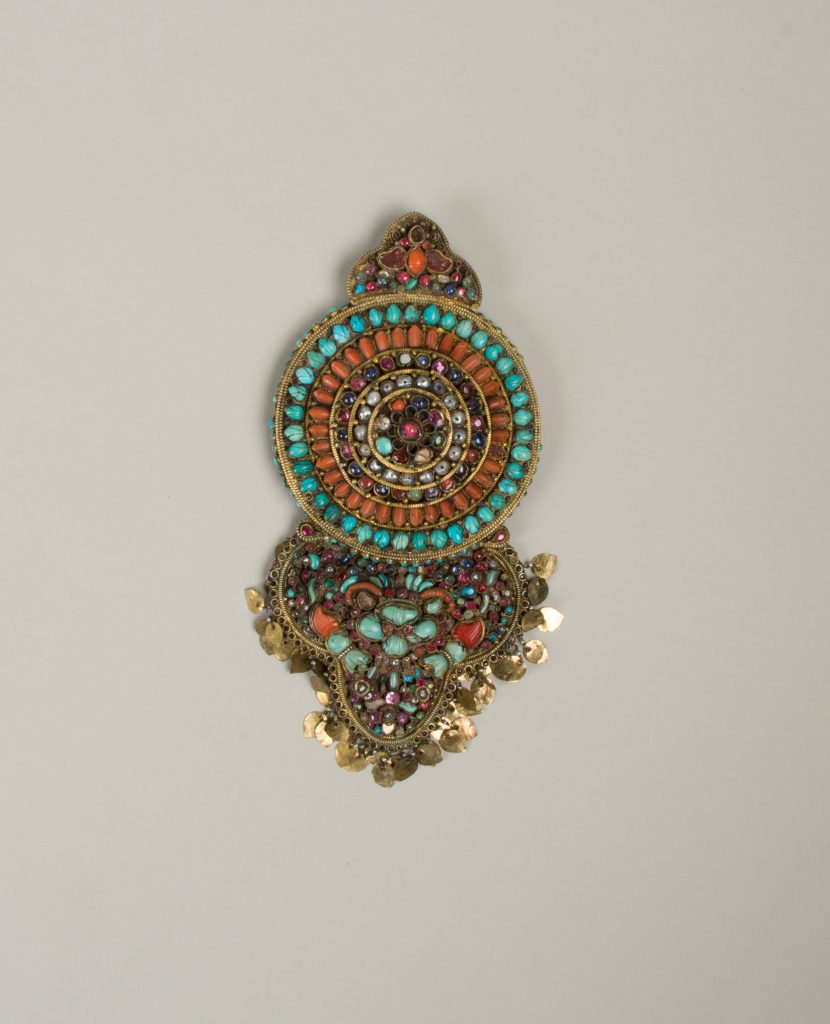
Header image: “Earring,” Tibet, 17th–19th century, The Metropolitan Museum of Art, John Stewart Kennedy Fund, 1915 (15.95.159), Open Access / public domain. This is a historical museum object, not a SILORU product.
The Metropolitan Museum of Art’s record for one Tibetan earring gives four useful facts: it is catalogued as jewelry, dated broadly to the 17th–19th century, described as silver gilt with precious and semi-precious stones, and measured at 6¼ by 3 inches (15.9 by 7.6 cm). Those facts make the object worth a closer look. They do not tell us who made it, how it felt to wear, or what any modern earring is made of.
Start with the recorded dimensions
The Met’s dimensions describe this particular object. The photograph alone does not give a reliable sense of scale; the label does. A historical earring of this size is also a reminder that “earring” covers very different forms across times and places. When considering a contemporary piece, look for that item’s own measurements and weight rather than using a museum example as a fit guide. (Met object record)
Read materials as an object-specific statement
The Met records silver gilt with precious and semi-precious stones. Its public label does not name every colorful inlay visible in the photograph, so the image should not be used to identify them one by one. Color is a visual clue; material identification needs an object record or reliable product documentation. For a modern accessory, ask for the exact item’s components and any treatment or plating information that matters to you. (Met object record)
Notice where a catalog is uncertain
Museum records do not always offer the same degree of certainty. The British Museum catalogues a pair of ear ornaments made with coral and turquoise, but marks their production place as Nepal (?) and Tibet (?). Those question marks matter: the museum is documenting uncertainty, not offering two firm origins. The pair is a separate object from the Met earring and should not be used to fill gaps in the Met record. (British Museum object record)
What this means for today’s earring descriptions
When an accessory is called “Tibetan-inspired,” ask which part of the description is about visual design and which part is a verified product fact. A resemblance to a historical ornament does not establish origin, age, handmade production, stone identity, or religious status. Specific claims should be supported for the specific item.
The practical habit is simple: look at the whole piece, read its dimensions and materials, then follow the source behind any cultural claim. SILORU’s guide to checking material information offers more questions to use when comparing contemporary accessories. For the object pictured above, return to The Met’s collection record.
Leave a Reply