


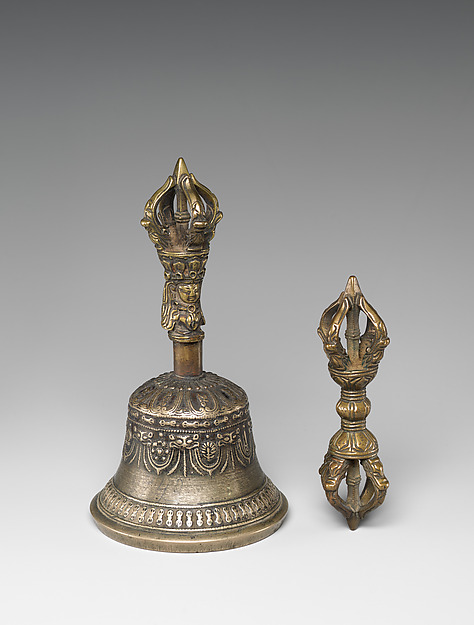
A vajra and a bell often appear side by side in Tibetan Buddhist art. They are a ritual pair, not two interchangeable ornaments: the vajra (Tibetan dorje) is associated with method or compassionate action, while the bell (dril-bu) is associated with wisdom. The Rubin Museum’s Project Himalayan Art explains their pairing as the union of these two aspects of practice.
What do the two objects look like?
The vajra is a small, symmetrical scepter with prongs at both ends. A ritual bell has a handle and a sounded body; its handle may echo the vajra’s prongs. Look at the 19th-century Tibetan bell and scepter in The Met’s collection: the matching pronged forms make the relationship visible, even before reading the label. The museum describes this particular pair as bronze and records the objects together.
Why are they used together?
In the Tibetan Buddhist ritual context described by The Met, the bell is held in the left hand and the scepter in the right during recitation. The museum identifies them as matched liturgical instruments. Their meaning belongs to that practice; a decorative bell shape on an accessory does not, by itself, establish that the accessory is a ritual implement or has been blessed. See The Met’s object record for the specific pair.
A useful way to read a museum label
Start with the object title, place, date and material. Then ask what the collection record actually supports. For The Met pair, “Tibetan,” “19th century,” and “bronze” are catalog facts; “Derge?” includes the museum’s own uncertainty about a more precise place. The form can invite comparison, but it cannot prove the origin or religious status of a modern design that merely resembles it.
When you encounter a vajra or bell motif in contemporary jewelry, ask for the maker’s material and production information separately. You can appreciate the visual reference while keeping its historical and ritual context intact. For a broader way to look at Himalayan objects, read SILORU’s Himalayan art looking guide.
Image note: The featured photograph shows “Dril-Bu and Dorje,” a 19th-century Tibetan museum object, not a SILORU product. Image: The Metropolitan Museum of Art, Open Access / public domain, object 502009.
Leave a Reply