


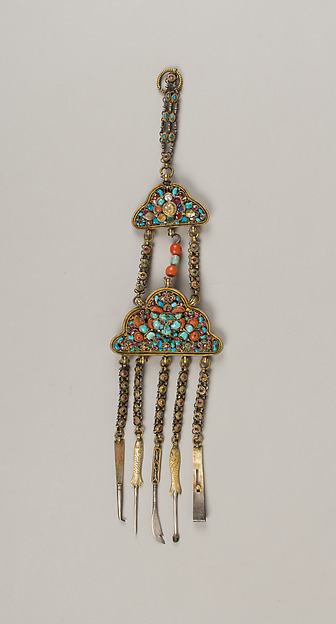
Jewelry can do more than frame the face or neck. A pair of woman’s belt hangings in The Metropolitan Museum of Art combines colorful adornment with small grooming tools. The museum catalogs the pieces as “Newari for Tibetan market,” dated broadly to the 17th–19th century. That careful wording makes this an especially useful object for looking at how jewelry, practical use and cultural exchange can meet.
What hangs from the belt?
The Met identifies nail clippers, an ear pick, a nail cleaner, a pin and tweezers suspended below the decorated pair. It also says such personal grooming tools were part of elaborate jewelry ensembles worn by women on important occasions. The tools are part of the object’s recorded function, not a meaning inferred from its colors. See the museum’s object description for that distinction.
Why does the label say “Newari for Tibetan market”?
The phrase separates a maker or workshop tradition from the market for which an object was made. The Met’s catalog does not label this pair simply “made in Tibet.” A Met curator’s discussion of Himalayan art notes that Newari workshops in Nepal produced high-quality jewelry found in Tibetan Buddhist contexts during this broad period. The record for this particular belt hanging is the stronger source for its own attribution; it does not identify an individual maker or wearer.
What can its materials tell us?
The catalog lists gilt silver, rubies, emeralds, sapphires, coral, shell, lapis lazuli and turquoise. These are documented materials for this museum object. A bright stone in a present-day accessory cannot be identified by color alone, and a visual resemblance cannot establish the same materials, origin or age. Those claims need evidence for the actual piece under discussion.
A better question for contemporary jewelry
When a design draws on a historical accessory, ask which feature is being referenced: its shape, the idea of suspended elements, its color arrangement, or a specific use. Then ask the maker separately about the modern piece’s materials and production. That keeps a striking historical object visible as its own work, without turning its catalog facts into unsupported claims about a product. For another close reading of a historical ornament, see SILORU’s Tibetan earring museum-label guide.
Image note: The featured photograph shows “Woman’s Belt Hangings,” object 15.95.171 in The Metropolitan Museum of Art. It is a historical museum object, not a SILORU product. Image: The Met Open Access / public domain.
Leave a Reply