


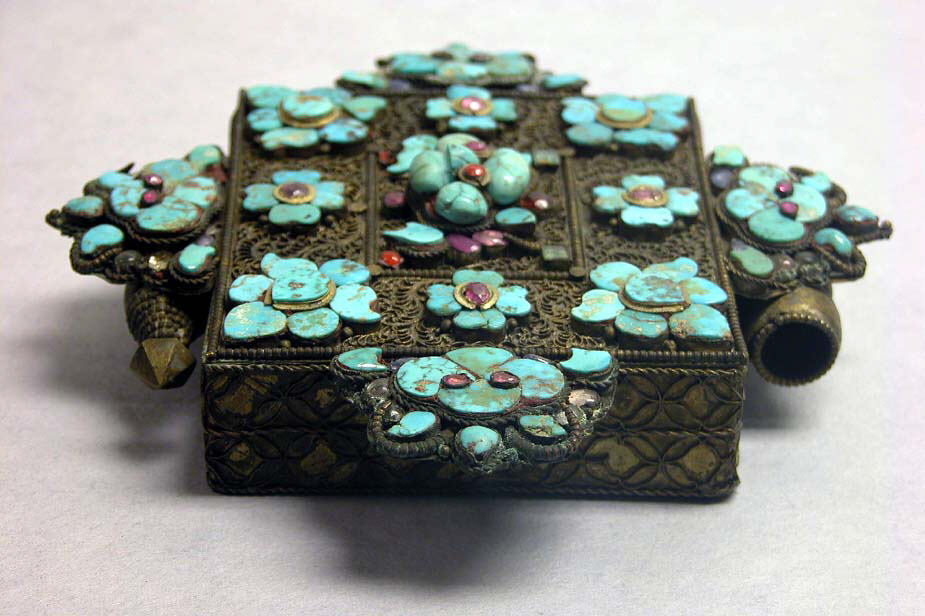
Header image: “Amulet Case,” Tibet, 17th–19th century, The Metropolitan Museum of Art, John Stewart Kennedy Fund, 1915 (15.95.172), Open Access / public domain. This is a historical museum object, not a SILORU product.
A gau (also spelled ga’u) is a portable amulet box used in Tibetan Buddhist and Bon settings. It may be worn, but its role cannot be understood from the outside alone: a box can hold texts, images, or other religious items, and its meaning depends on its contents, owner, and practice. A pendant that resembles a gau is therefore not automatically a ritual object. (Rubin Museum, Project Himalayan Art)
A box that can be worn
The Metropolitan Museum of Art describes a late 19th- to early 20th-century Tibetan Amulet Box of a Noblewoman designed to be worn as a necklace. The Met classifies that specific object as jewelry and records its goldwork and inlaid stones. Its description says boxes of this type would have held written or printed texts consecrated by monks. This is a record of one historical kind of wearable box, not a material or religious claim about every gau. (Met object record)
Other museum examples differ in size and form. The Smithsonian’s National Museum of Asian Art catalogues a round amulet box with a fabric storage case as a container from Tibet. The Rubin Museum catalogues a 19th-century gau as a ritual object and describes its central window and elaborate decoration. These labels are useful precisely because they identify particular objects rather than treating every box-shaped pendant as interchangeable. (Smithsonian object record; Rubin object record)
Why the contents matter
A gau can be a portable setting for sacred items. In an essay for Project Himalayan Art, scholar James Gentry examines one example prepared in Kathmandu in the early 21st century and describes its specific contents and consecration. The details are tied to that particular box and its owners. A photograph of a closed gau—or a contemporary accessory inspired by its outline—cannot establish what is inside or whether any religious preparation took place. (Rubin essay)
Three questions when you see a gau-like design
- Is it documented as a container? An opening, back, or window may suggest a box, but a product description should explain its actual construction.
- What is known about this exact object? For a museum work, read the collection record. For a modern accessory, check its maker, materials, dimensions, and intended use.
- What is being claimed? A gau-inspired shape does not prove Tibetan origin, consecration, protective power, or a link to a particular lineage.
The distinction lets us appreciate the visual design of an accessory while respecting the religious context of historical gaus. If you are new to reading museum labels, SILORU’s guide to looking at Himalayan art offers a simple starting point. For the object pictured above, see The Met’s collection record.
Leave a Reply