


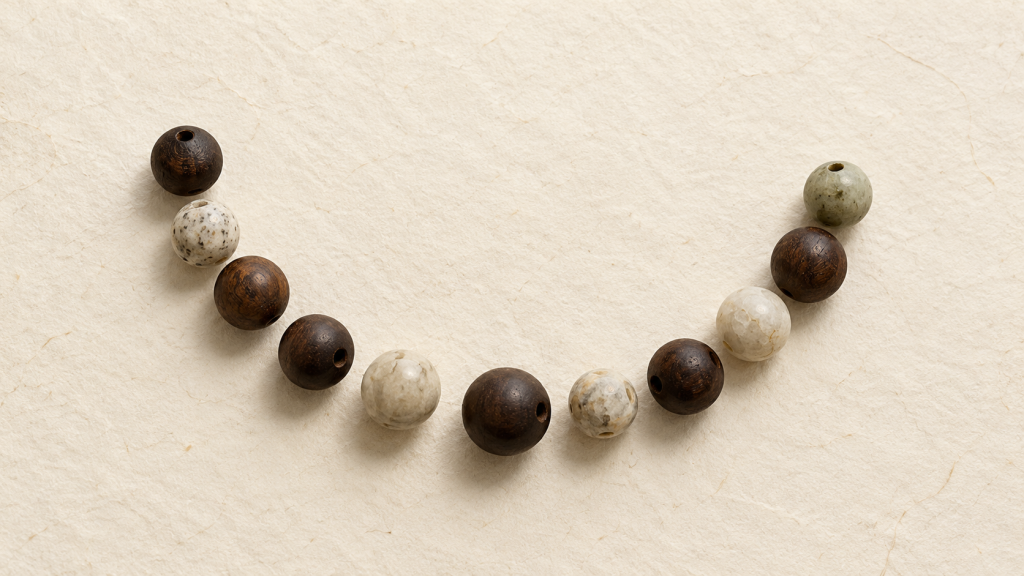
Illustration note: The header image is an AI-generated editorial arrangement of loose beads. It is not a historical prayer strand or a SILORU product.
Some Tibetan Buddhist prayer beads are arranged in sets of 108, but that number does not describe every strand. A 19th-century Tibetan set in the Rubin Museum of Himalayan Art has 108 beads; a 20th-century short strand in the same collection has 100 turquoise disks. Looking at both makes a better starting point than treating any bead count as a universal rule.
What are prayer beads used for?
In Tibetan Buddhist practice, beads can help a practitioner count recitations of prayers or mantras. The Rubin Museum describes its 108-bead strand as a personal religious object, with two attached counters used to track completed rounds. Its record identifies that particular object as turquoise, carved bone, and silver, and notes that it once belonged to a princess of Derge. Those details belong to the museum’s documented strand; they do not describe other beads that merely look similar. (Rubin object record)
Why 108—and why not always 108?
The Rubin record calls 108 a standard number for that long strand and connects it to Buddhist literature and older Indian beliefs. It also describes the strand’s dividing beads in groups of 27. Yet the museum’s shorter trengwa has 100 disks. For the short strand, the museum offers more than one possible explanation of its number and does not settle on a single one. That is a useful reminder: the count can be meaningful, practical, or uncertain without additional context. (108-bead record; 100-disk record)
A bead strand is more than its count
The short strand includes conch-shell separators and personal additions such as other beads and buttons. The Rubin describes these as signs of its previous owner’s taste. In a past exhibition on Asian prayer beads, the museum also emphasized that strands can differ in structure, materials, counters, and personal embellishments across traditions. Comparing objects therefore means reading their individual records, not just counting circles in a photograph. (Rubin short-strand record; Count Your Blessings exhibition)
What should a shopper ask about a bead accessory?
If you are looking at a contemporary bracelet or necklace, separate three questions:
- What does the piece visibly show? A bead count and color may be observable, but a photo may not reveal every bead or its material.
- What does its maker or seller document? Look for specific materials, origin, dimensions, and intended use for that exact item.
- Is a religious claim being made? A design inspired by a bead tradition is not automatically a prayer strand, a blessed object, or a source of spiritual results.
The distinction protects the meaning of documented ritual objects and helps readers evaluate modern accessories on their own stated facts.
Leave a Reply