

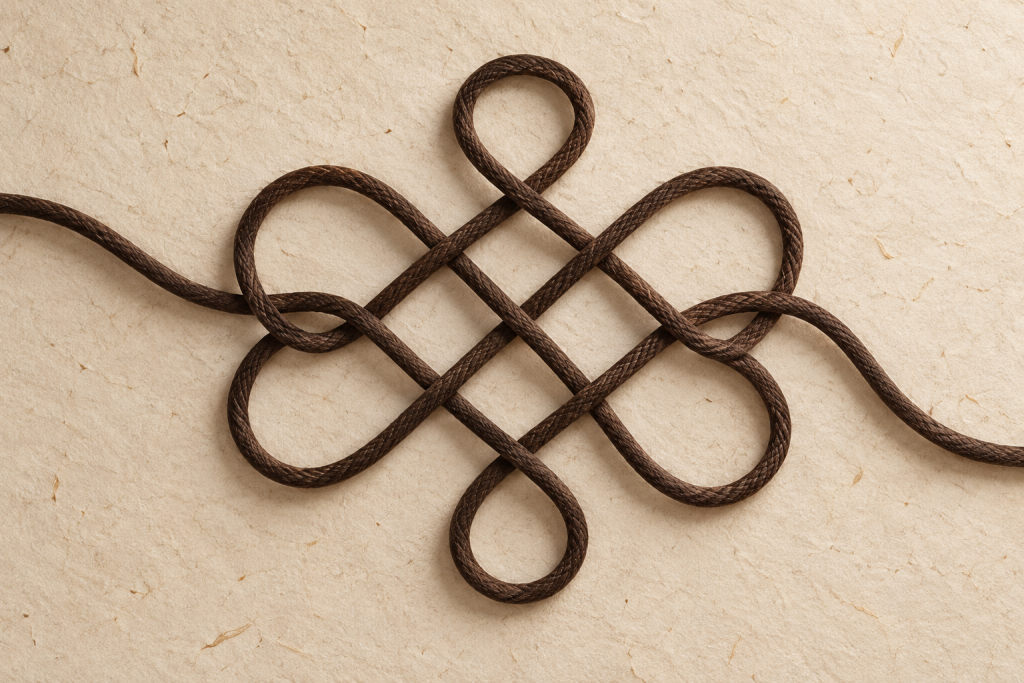
Illustration note: The header image is an AI-generated editorial concept of an interlaced cord, not a historical Tibetan object or a SILORU product.
The endless knot is one of the Eight Auspicious Symbols seen in Tibetan Buddhist art. Its interlacing path has no obvious beginning or end, which helps explain why people connect it with continuity. But a knot motif on a pendant, textile, or painting does not tell you everything about that object. To understand it, start with the object’s documented place, purpose, and maker when those facts are available. (Horniman Museum; Metropolitan Museum of Art)
What is the endless knot?
The Metropolitan Museum of Art lists the endless knot among a group of eight auspicious motifs that also includes the lotus, wheel, conch, parasol, victory banner, vase, and pair of fish. The Met notes that these motifs appear across different types of Tibetan objects, sometimes as the central feature and sometimes as a small accent. That range is one reason to look at the whole object before assigning a meaning to a detail. (Met essay)
A Smithsonian collection record documents all eight emblems in a set of ceremonial metalwork from central Tibet. That is evidence for this specific historical set. It is not evidence that every modern object bearing a knot has the same origin or role.
Does the knot have one fixed meaning?
No single short phrase captures every use. The Horniman Museum describes an endless knot woven into the fabric mount of a thangka, a Tibetan Buddhist scroll painting. Its record observes that the line has no start or finish and notes that multiple meanings have been attributed to the symbol. The painting’s religious context matters to how that particular knot is understood. (Horniman object record)
In a different setting, a knot-shaped detail may be decorative, devotional, or part of a wider design. Without a trustworthy object record or information from its maker or community, it is better to describe what you can see than to announce a definitive spiritual interpretation.
How should you read an endless-knot accessory?
Ask three separate questions:
- What is visible? Look at the pattern itself and whether it is carved, cast, woven, or printed. A photograph may not reveal the technique clearly.
- What is documented? Check the seller’s or maker’s specific material, origin, and production information. A motif cannot verify any of these facts on its own.
- What is claimed about its meaning? Notice whether the description identifies a source or tradition. A symbol associated with auspiciousness is not a guarantee of luck, protection, or a personal outcome.
This way of reading keeps cultural context and product facts distinct. It also leaves room for people who use the motif in living religious practice to explain what it means to them, rather than treating one retail description as the last word.
A closer way to look
The endless knot can invite attention because the eye follows its crossing lines. Let that be a starting point for learning, not a shortcut to certainty. If you would like a broader guide to observing objects and their labels, read SILORU’s first-time visitor guide to Himalayan art. For a documented historical example, see the Horniman thangka record.
Leave a Reply